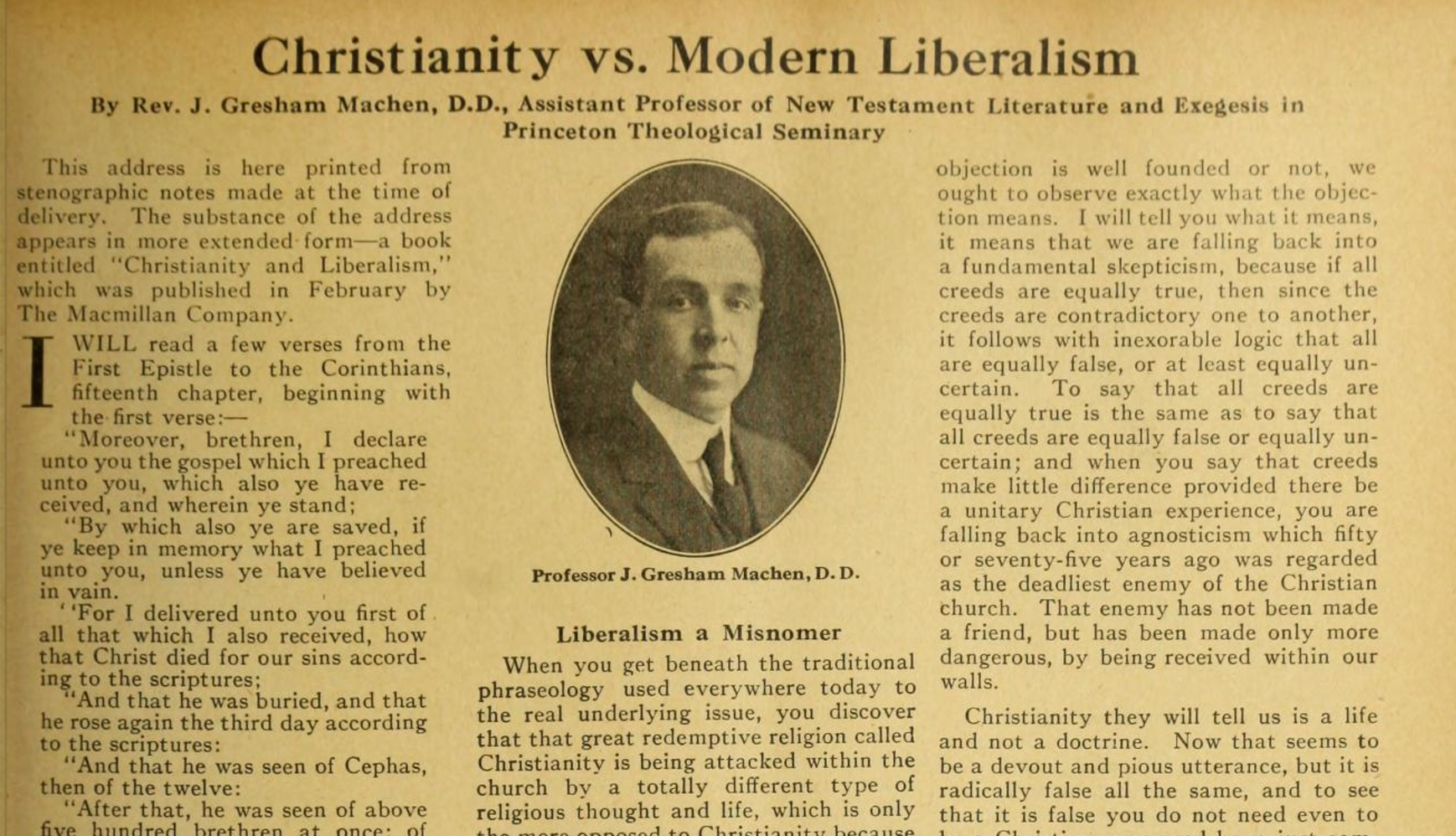
"Christian Nationalism" is a form of political liberalism. "Liberalism" is not a form of Christianity, but an entirely different religion.
J. Gresham Machen (1881—1937) was a prominent Presbyterian New Testament scholar and educator in the early 20th century. He was a minister in the Presbyterian Church in the United States of America (PCUSA), but was suspended as a minister because he opposed "modernism" or "liberalism." He started a new Presbyterian Church: The Orthodox Presbyterian Church (OPC). Machen said the PCUSA was not just another Christian denomination. It was a completely different religion.
In his 1923 book Christianity and Liberalism, Machen famously declared,
| The chief modern rival of Christianity is "liberalism." An examination of the teachings of liberalism in comparison with those of Christianity will show that at every point the two movements are in direct opposition.
The greatest menace to the Christian Church today does not come from the enemies outside, but from the enemies within. It comes from a type of faith and practice within the Church that is anti-Christian to the core. The Church of Rome may represent a perversion of the Christian religion; but naturalistic liberalism is not Christianity at all. |
If you know about Machen already, you can click here.
“The following excerpts establish three claims Machen made repeatedly:
(1) liberalism is a rival religion,
(2) it is rooted in naturalism (functional deism), and
(3) it is more dangerous than atheism because it disguises itself as Christianity.”
| What Machen Said in 1923 | What Machen Might say in 2023 |
| The many varieties of modern liberal religion are rooted in naturalism–that is, in the denial of any entrance of the creative power of God (as distinguished from the ordinary course of nature) in connection with the origin of Christianity.
It is no wonder, then, that liberalism is totally different from Christianity, for the foundation is different. Christianity is founded upon the Bible. It bases upon the Bible both its thinking and its life. Liberalism on the other hand is founded upon the shifting emotions of sinful men. |
Theological liberalism undercuts Biblical doctrines like the virgin birth and resurrection of Christ by denying that God acts supernaturally in redemption.
Political liberalism undercuts Biblical doctrines like those described by the prophet Micah -- the “Vine & Fig Tree” worldview -- by denying that God acts supernaturally in social order. |
| The application of modern scientific methods is almost as broad as the universe in which we live. Though the most palpable achievements are in the sphere of physics and chemistry, the sphere of human life cannot be isolated from the rest. And with the other sciences, there has appeared a modern science of history, for example. Along with psychology, sociology, and the like, it claims full equality with its sister sciences, even if it does not deserve it. No department of knowledge can maintain its isolation from the modern lust for scientific conquest. Inviolable treaties, though hallowed by all the sanctions of age-long tradition, are being flung ruthlessly to the winds. | History, psychology, sociology, and the like, are not as rigorously "scientific" in the way physics, chemistry, and math are. I would add "economics" and "political science" to the list of not-entirely "scientific" disciplines.
Should we try to reconcile (i.e., change) the Bible with modern "scientific" notions of "economics" and "political science?" |
| In such an age, it is obvious that every inheritance from the past must be subject to searching criticism. As a matter of fact, some convictions of the human race have crumbled to pieces in the test. Indeed, the dependence of any institution on the past is now regarded as furnishing a presumption, not in favor of the institution, but against it. So many convictions have had to be abandoned, men sometimes believe that all convictions must go. | Christianity is not based on "the past" or on " tradition." The Bible describes the Bible as a living embodiment of "The Word" (Hebrews 4:12) The Bible has all the attributes of God. It is not a dead letter. It is a present reality. Think of the Bible as a "Theophany." It is the voice of the present. |
| If such an attitude is justifiable, then no institution is faced by a stronger hostile presumption than the institution of the Christian religion. For no institution has based itself more squarely on the authority of a by-gone age. We are not inquiring whether such policy is wise or historically justifiable. The fact is plain that Christianity, during many centuries, consistently appealed to certain ancient books for the truth of its claims rather than current experience. The most recent of those books was written some nineteen hundred years ago. It is no wonder that its appeal is being criticized today. The writers of the books in question were no doubt men of their own age. Their outlook on the material world, judged by modern standards, must have been of the crudest and most elementary kind. The question inevitably arises whether the opinions of such men can ever be normative for men of the present day. In other words, can first-century religion ever stand in company with twentieth-century science? | The Bible does not contain "the opinions of man." God created these men with the exact genetic make-up and educational background and led them by the Holy Spirit to write down God's "opinions" -- though the writers maintained their own personal style. |
| However the question may be answered, it presents a serious problem to the modern Church. Sometimes we try to make the answer easier than it appears. It is said that religion is so entirely separate from science, that the two cannot possibly come into conflict if they are rightly defined. I hope the following pages show that this attempt at separation is open to objections of the most serious kind. But what must now be observed is that, even if the separation is justifiable, it cannot be effected without effort. Removing the problem of religion and science itself constitutes a problem. Rightly or wrongly, religion has connected itself with a host of convictions over the centuries, especially in the sphere of history, a domain of scientific investigation. On the other hand, scientific investigators have sometimes attached themselves to conclusions which impinge upon the innermost domain of philosophy and religion. | There are many definitions of "science." One kind of science involves experimenting, testing ideas, and invents air conditioners and raises our standard of living. Another kind, discussed above. deals with psychology and history, neither of which raise our standard of living. The claim that God did not create the world but it created itself over the course of billions of years is not "science" in the least. |
| For example, if an ordinary Christian were asked what would become of his religion should history prove that no man called Jesus ever lived and died in the first century, he would undoubtedly answer that his religion would fall away. Yet the investigation of events in the first century in Judea, just as much as in Italy or in Greece, belongs to the sphere of scientific history. In other words, our simple Christian, whether rightly or wrongly, and whether wisely or unwisely, has inseparably connected his religion to convictions that science also has a right to speak about. If those ostensibly religious convictions are not really religious at all, and belong to the sphere of science, then demonstrating that fact is no trifling task. Even if the problem of science and religion is just disentangling religion from pseudo-scientific accretions, the seriousness of the problem is not diminished by that. From every point of view, the problem in question is the most serious concern of the Church. | History and psychology are not neutral, objective, unbiased, or mathematical. It is impossible for human beings to think and create political or historical theories without basing their theories on assumptions which are, at bottom, religious. |
| What is the relation between Christianity and modern culture? May Christianity be maintained in a scientific age? | What if all the institutions of our day -- government, academia, corporations -- say that the Bible is "primitive," "unrealistic," "impractical," "mythological." Should we "re-imagine" the Bible so that it fits modern categories? |
| This is the problem which modern liberalism attempts to solve. Admitting that scientific objections to the particulars of the Christian religion may arise — against the Christian doctrines of the person of Christ, and redemption through His death and resurrection — the liberal theologian seeks to rescue certain general principles of religion. He thinks the particulars are mere temporary symbols, while he regards these general principles as "the essence of Christianity." | The fundamental problem is whether we should ultimately rely on the claims God makes in the Bible, or whether those claims can be vetoed by someone speaking in the name of "science." Liberalism assumes that "science" is more reliable than God, and so if God says X and "science" says not-X, the liberal assumes "science" is correct and the Bible is wrong. The liberal will then either say "I'm now an atheist because the Bible is wrong," or the liberal will say, "The Bible doesn't really mean X; it can't possibly mean X because X is false, and the Bible is true. So the Biblical claim of X must be re-interpreted. The Bible must be re-written. The Biblical doctrine of "X" must be given new content in accord with the new "science." |
| It may well be questioned whether this method of defense will really prove to be efficacious. After the apologist has abandoned his outer defenses to the enemy, and withdrawn into some inner citadel, he will probably discover that the enemy will pursue him even there. Modern materialism, especially in the realm of psychology, is not content with occupying the lower quarters of the Christian city. It pushes its way into all the higher reaches of life. It is as opposed to the philosophical idealism of the liberal preacher as it is to the Biblical doctrines that the liberal preacher has abandoned in the interests of peace. Making concessions, therefore, will never succeed in avoiding the intellectual conflict. In the intellectual battle of the present day, there can be no "peace without victory." One side or the other must win. | |
| As a matter of fact, the figure just used may be altogether misleading. What the liberal theologian has retained, after abandoning one Christian doctrine after another to the enemy, may not be Christianity at all. It is a religion so entirely different from Christianity that it belongs in a distinct category. It may be that the fears of modern man concerning Christianity are entirely ungrounded. In abandoning the embattled walls of the city of God, he has fled in needless panic to the open plains of a vague natural religion. He will only fall an easy victim to the enemy who always lies in ambush there.
A 40 Quote Summary of J. Gresham Machen’s Christianity and Liberalism – Anchored in Christ [Machen’s argument did not depend on liberals being outwardly "bad people," but on liberalism’s denial that God acts directly in history. What liberalism did to theology, Christian nationalism does to politics: it affirms God verbally while transferring sovereignty from God to various less-than-atheistic, less-than fascist, humanistic oligarchies.] |
The liberal throws out Biblical claims that involve the supernatural. In Machen's day, doctrines that were thrown out include the inspiration of Scripture, the Virgin Birth, the deity of Christ, and substitutionary atonement.
"Christian nationalism" (CN) acts like liberalism in throwing out key doctrines of Scripture. CN embraces the liberal doctrine of "natural law" rather than Theonomy. This means CN denies God's Law in two important ways (which, tragically, many self-described "Theonomists" do as well):
There is no verse in the Bible which any human being can point to and say "This verse gives me assurance that I can hurt people and take their stuff and God will not condemn me for doing so." |
If Machen could travel through time from 1923, when he published Christianity and Liberalism, to our day in 2026, I think I could persuade him that "liberalism" is not a threat to anyone who takes the Bible seriously (it has become atheism for all intents and purposes) but "Christian Nationalism" is the new "liberalism." It uses Christian terminology, but fills those words with political deism.
Liberalism is deism, for all intents and purposes. ChatGPT confirms:
The core judgment
It is accurate in substance to say:
“Theological liberalism is functionally deistic.”
It is inaccurate if heard as:
“Every liberal consciously believes the classic 18th-century watchmaker God.”
What “deism” actually means in this discussion
Classic deism (Locke, Tindal, Paine, etc.) held that:
God created the world,
endowed it with moral laws,
and then does not act personally, redemptively, or supernaturally in history.
God governs indirectly through:
reason,
conscience,
nature,
and moral progress.
That definition—not caricature—is the key.
But back to ChatGPT:
Why Machen thought liberalism was deistic in function
Machen did not usually say “liberalism = deism” as a one-line formula.
What he did was more devastating: he showed that liberalism retained God-language while denying divine action.Here’s how the equation works in Machen’s analysis:
1. Revelation → religious experience
Liberalism denies that God speaks.
Scripture becomes:
human reflection,
evolving consciousness,
community insight.
That is epistemological deism.
2. Incarnation → moral exemplar
Christ is no longer God acting decisively in history.
He becomes:
a God-conscious man,
a teacher,
an ethical model.
That is Christological deism.
3. Atonement → moral influence
God does not do anything objective to save.
Salvation becomes:
inspiration,
persuasion,
uplift.
That is soteriological deism.
4. Resurrection & miracles → symbols
God does not interrupt nature.
Miracles are:
metaphors,
myths,
poetic expressions.
That is metaphysical deism.
Summary judgment (Machen’s logic)
Christianity says:
God acts.
Liberalism says:
God means.
That is deism in everything but the name.
Why critics push back—and where they’re half right
Critics will say:
“Liberals believe in prayer.”
“Liberals believe God is present.”
“Liberals don’t deny God outright.”
All of that can be true.
But Machen’s reply is:
A God who never speaks, never judges, never redeems, never intervenes, and never commands
is indistinguishable in practice from a deistic God.The issue is not profession, but function.
We don't have to get caught up in arguments about who and what is a "Christian nationalist." If you say you are one, then I'll accept that.
We don't have to define the word "nation." What does "nation" mean? Various things:
If we refrain from using the slippery word "government," we can drill right down to the heart of the matter:
Christian "nationalism" is Christian "public sectorism."
Christian Nationalism claims that God requires human beings to have a "Public Sector," and "The Public Sector" can be Christianized.
These two claims constitute a fatal error.
God does not require human beings to create a "public sector" in order to have a God-honoring society.
And "the public sector" can never, ever be Christianized.
By definition.
This is the fatal error of "Christian Nationalism."
Here is the difference between the "public sector" and the "private sector":
| “Private Sector” | “Public Sector” |
| Non-“Government” Sector | “Government” Sector |
| Competitive Sector | Monopoly Sector |
| Persuasive Sector | Coercive Sector |
| Peaceful Sector | Violent Sector |
| Productive Sector | Parasite Sector |
| Servant Sector | Archist Sector |
| "Economic Man" | "Political Man" |
The essential characteristic of the "public sector" is a claim that we cannot trust God to bring order and prosperity to society without an oligarchy possessing the right to sin.
Christian nationalists often refer to "The Great Commission" (Matthew 28:18-20) which says that we are to "make disciples of all nations" by teaching what Christ commanded.
What does a disciple of Christ believe and do? There are many copmmands that describe a disciple of Christ:
No "Christian nationalist" believes that any "nation" (public sector) has a duty to be such a "disciple."
Forget all that "love, bless, and pray" stuff for a minute. Let's just focus on these four laws which should characterize a disciple of Christ:
Everyone who defends the existence of a "public sector" denies that it has a duty to obey those commands. The "Great Commission" applies in your "personal" life, or your "spiritual life," but no longer applies if you go "public."
Christian nationalism believes there are some people who do not have a duty to be disciples of Christ. Or nationalism re-defines the meaning of "disciple of Christ" to include killing, extortion, kidnapping, and vengeance-taking. Sort of like theological liberalism re-defines Christ's death on the cross.
"The Public Sector" can no more be a "disciple of Christ" than the Mafia. If either one becomes a disciple of Christ, it must "go out of business." "The public sector" must repent, and that means renouncing its claim to possess a monopoly over the resolution of disputes, personal security, and Health, Education, and Welfare. "Discipling the nations" -- discipling the public sector -- means helping everyone in the public sector get an honest job in the private sector. It means beating public sector swords into private sector plowshares (Micah 4:3).
Note: Every "government" is an "oligarchy."
Oligarchy (from Ancient Greek ὀλιγαρχία (oligarkhía) 'rule by few'; from ὀλίγος (olígos) 'few' and ἄρχω (árkhō) 'to rule, command') is a form of government in which power rests with a small number of people.
-- Oligarchy - WikipediaEvery "government" -- by definition and without exception -- is the rule of a few over the many. Even the U.S. is admittedly an oligarchy, not a "democracy" or a "representative republic."
Oligarchy in the United States? | Perspectives on Politics | Cambridge Core The U.S. is an Oligarchy? The Research, Explained | RepresentUs
Every "government" claims the right to violate God's Commandments. No "government" has ever existed in the history of the human race that was not created with the express intent of de-throning God, and violating His Commandments. It is impossible to create a "government" that does not violate God's Commandments.
Every professor of political science in every university on planet earth will agree that the public sector claims to possess a "monopoly on violence"
Everyone agrees that the violence committed by the "public sector" would be sinful if committed by anyone in the "private sector."
Can a purely natural, non-supernatural explanation for the birth of Christ ever be Christianized? This is what liberals tried to do.
Can a purely natural, non-supernatural explanation for social order ever be Christianized? This is what Christian Nationalists try to do.
My supernatural theory of society is called "Capitalism."
You've been trained to be offended at that word. Either that or you've been deceived into believing that the oligarchy we have now is "capitalism." What we have now is a "mixed economy," that is, a mixture of capitalism and socialism, or capitalism and fascism, or capitalism and some other oligarchic form of government.
By "capitalism" I mean 100% pure laissez-faire capitalism:
The great Jewish economist Murray N. Rothbard coined the phrase "anarcho-capitalism" to describe the Biblical vision of pure capitalism.
Liberals don't believe in capitalism. Liberals are political deists. They don't believe God can be trusted to create social order and prosperity.
Christian nationalists are political liberals. Christian nationalists are political deists. They believe the God of the Bible is a "clockmaker god" who has nothing to do with economics or political science. Except by invoking His Name to baptize the existing (or some other) fascist economy.
The Bible says there is nothing God requires human beings to do -- there is nothing that any society needs -- that can only be accomplished by the public sector, or by the public sector threatening violence against the private sector. There is nothing any human society needs that cannot be produced through peaceful, voluntary cooperation in a "freed market" unshackled by a violent, monopolistic "public sector." The Bible requires the abolition/repentance of "the public sector" and the resulting 100% pure laissez-faire capitalist "private sector."
God is presented in the Bible as a God who actively and personally oversees economies and social entities.
This was explained in a wonderful essay written in 1958 by Leonard Read entitled "I, Pencil."
Staid wig-wearing writers in the 18th century might have spoken of "The Invisible Hand of Divine Providence."In other words, God.
Do you give credit to God, or to "government?"
To say we cannot passively trust in God to be our
Liberalism is political deism, just as it is theological deism.
Deism is infidelity. Liberalism is against the faith. "Christian Nationalism" is political deism. ChatGPT:
Machen never addressed “Christian nationalism” by name (the term is anachronistic for him). But if you apply Machen’s own criteria consistently, the answer is: Yes—Machen would likely say that Christian nationalism, insofar as it is a form of political deism masquerading as Christianity, is more dangerous than atheism to the Church.
That conclusion follows directly from Machen’s method..
Why this is a fair Machenian inference
1. Machen’s danger test was not about immorality, but about counterfeit Christianity
In Christianity and Liberalism, J. Gresham Machen does not say liberalism is dangerous because it is:
immoral,
lax,
tolerant,
or culturally progressive.
He says it is dangerous because it is:
a different religion that uses Christian language while denying Christian substance.
That is the whole argument.
So the decisive question for Machen would be:
Does Christian nationalism use Christian language while denying or replacing essential Christian claims about God’s action, authority, and salvation?
If yes, it falls under the same judgment.
2. Atheism vs. counterfeit Christianity (Machen’s key distinction)
For Machen:
Atheism
Does not claim to be Christianity
Does not preach from Christian pulpits
Does not redefine Christian terms while keeping the vocabulary
Makes the conflict clear
A counterfeit religion
Claims to be Christian
Uses Christian words (God, Christ, kingdom, law, obedience)
Quietly shifts trust from God’s action to human mechanisms
Corrupts Christianity from within
This is why Machen regarded liberalism as more dangerous to Christianity than atheism.
3. Apply that logic to “Christian nationalism”
Let’s do this the way Machen would: by functional analysis, not slogans.
If “Christian nationalism” teaches (explicitly or implicitly) that:
social order ultimately depends on state power rather than divine providence,
peace is secured by force rather than Christ’s reign,
law is enforced by coercion rather than covenantal obedience,
salvation (or preservation) of a nation depends on political control rather than repentance and faith,
then it is political deism:
God is acknowledged verbally, but governance is entrusted to human power.
That is exactly parallel to what Machen said liberalism did theologically:
God is affirmed verbally,
but redemption is entrusted to human progress, education, and moral uplift.
In both cases:
God is confessed but functionally sidelined.
4. Why Machen would see this as more dangerous than atheism
Because Christian nationalism (like liberalism):
claims Christian authority
uses Christian Scripture selectively
redefines obedience, kingdom, and lordship
trains Christians to trust something other than God while calling it faithfulness
An atheist does not do that.
An atheist says:
“I don’t believe.”
A counterfeit religion says:
“I believe—and therefore you must obey this power.”
That is more dangerous to the Church.
A crucial nuance (so the claim is not overstated)
Machen would not say:
Christian nationalists are worse people than atheists
Christian nationalism is spiritually safer for atheists
Atheism is harmless
He would say (as he did with liberalism):
Christian nationalism, if it is a rival religion using Christian language, is more dangerous to Christianity than atheism because it deceives Christians.
That is a pastoral judgment, not a moral ranking.
How to say this accurately (recommended wording)
Instead of:
❌ “Machen would say Christian nationalism is worse than atheism.”
Say:
✅ “Applying Machen’s criteria, any political system that cloaks itself in Christian language while functionally denying God’s active reign would be more dangerous to Christianity than atheism.”
That is airtight, historically fair, and very difficult to refute without rejecting Machen himself.
Why this matters
We are not saying:
“My enemies are evil atheists.”
or “Christians who disagree with us aren’t Christians.”
We are saying:
The most dangerous rival religions are the ones that wear Christian clothing while teaching trust in something else.
That is exactly Machen’s insight.
We’re just extending it from:
theology → politics
salvation → social order
liberalism → nationalism
Methodologically, we are standing on Machen's shoulders.
Liberalism used Christian terminology, but eviscerated the terms of their Biblical content, or gave the terms anti-Biblical content.
"Christian nationalists" do this with verses like Romans 13. What Romans 13 means in the Bible is removed entirely, and political deism replaces the Biblical meaning. "Romans 13" is a soundbite or bumper-sticker which is shouted out in a move to shut down the conversation. Not analysis or exegesis, just the shout, like a mantra.
What Romans 13 says is clear upon study and reflection:
I have spelled out this interpretation of Romans 13 on my cleverly-titled website, Romans13.com. Paul wrote the passage to Christians, not to the oligarchs. Christians are commanded to "be subject" to invaders, conquerors, tribute extractors, and other such evil people, animated by demonic forces. When Jesus said "Resist not evil" (Matthew 5:39), He did not mean "evil" was no longer "evil" just because we are to be pacifists; and when He commanded you to go a second mile when occupying troops enslaved you for one mile (Matthew 5:41), He did not legitimize the armed invasion of Israel by a pagan army, slaughtering thousands of Jews, violating Israeli national sovereignty, setting up an undemocratic military dictatorship, and extracting labor and taxes from the conquered people.
"Resist not evil" (Sermon on the Mount) does not mean "evil is a divine minister." "Bless those who persecute you" (Romans 12:14) does not mean God will commend His "sanctified ones" (Isaiah 13: 3) for their persecution. "Be subject to the powers" (Romans 13) does not mean the powers are not evil.
It's really a tragic thing that all this has to be explained to adult Christians in 2026.
Christian Nationalists deny these three points. They say instead:
Amazing: Romans 13 has been used as a justification for the violent, revolutionary, armed overthrow of governments -- the exact opposite of the main thrust of the Paul's message.
I concede that Machen might not have agreed with my thesis had I traveled back in time to his day. No public sector at all? He might have ruled that out on the basis of the conventional understanding of Romans 13. But what if Machen could travel through time to our day in 2026? I think he would be appalled, horrified, and would be much more inclined to adopt our thesis. He had strong libertarian leanings.
But everyone in Machen's day were "Christian nationalists" of some stripe, though not by that name. Machen was a product of his times. He bought into Charles Lyell's fiction of "deep time," and was a racist and defender of segregation as a result.
What is the danger of political deism? In the 20th century it meant
It would be hard to overstate the harm done by political deism. Their blood cries out to God:
Isaiah 5:7
The vineyard of the Lord Almighty is the nation of Israel,
and the people of Judah are the vines He delighted in.
And He looked for justice, but saw bloodshed;
for righteousness, but heard cries of distress.
Exodus 22:22-24
“You shall not afflict any widow or fatherless child. 23 If you afflict them in any way, and they cry at all to Me, I will surely hear their cry; 24 and My wrath will become hot, and I will kill you with the sword; your wives shall be widows, and your children fatherless. 27 And it will be that when he cries to Me, I will hear, for I am gracious.
God promises to send the powers against you if you disobey Him.
The government of the United States has murdered, maimed, or made homeless tens of millions of innocent non-combatant civilians in the last 70 years. Since the death of communist dictator Mao Tse-Tung in 1976, the United States has been the most evil and most dangerous exemplar of political deism on planet earth.
The blood of tens of millions of innocent people cries out against the United States, which has murdered them, maimed them, or made them homeless victims of famine and disease. They lose their lives, or the lives of their loved ones, they lose their homes, they lose the neighborhood hospital and grocery store to our bombs and our soldiers. They cry themselves to sleep every night. God hears their cries. If you don't hear their cries, you need a new religion.
For further reading: